

The Galaxy System™ from Noah Medical

Galaxy System from Noah Medical

Meadville Medical Center, through Pulmonary Associates of Meadville, is proud to offer The Galaxy System™ from Noah Medical, the first and only image-integrated robotic-assisted bronchoscopy (iiRAB) system, designed to improve tool-in-lesion accuracy and procedural efficiency.

Lung cancer is the second most common cancer in the United States and the leading cause of cancer deaths in the country. But today, it can be difficult for physicians to properly find and biopsy lung nodules, delaying diagnosis and complicating treatment.

The Galaxy System from Noah Medical is a new, state-of-the-art robotic platform that enables physicians to navigate to and locate lung nodules with greater precision and accuracy thancurrent robotic platforms. Its “Tool-in-Lesion” TiLT+Technology has been shown to achieve 100% successful navigation to lesion, 100% diagnostic yield and 95% tool-in-lesion accuracy in the recent MATCH study publication.

With Galaxy, physicians can now diagnose and treat lung nodules sooner, and reduce the potential for infection from improperly cleaned reusable scopes because of Galaxy’s single-use bronchoscope, the first of its kind in robotic bronchoscopy.

Early Detection Saves Lives

In its early stages, lung cancer does not typically cause signs or symptoms. Unfortunately, signs and symptoms start to occur when the disease is already advanced and can include1:

  • A cough that does not go away or gets worse
  • Coughing up blood
  • Shortness of breath or chest pain
  • Hoarseness or new onset of wheezing
  • Loss of appetite or unexplained weight loss
  • Feeling tired or weak

5-Year Survival Rate3,4

0 %

Stage I Lung Cancer

0 %

Stage IV Lung Cancer

A Leading Cause of Cancer Death

Lung cancer accounts for about 1 in 5 of all cancer deaths in the United States2. It can be classified as one of two types–small cell or non-small cell lung cancer (NSCLC). NSCLC is more common and includes adenocarcinoma, squamous cell carcinoma, and large cell carcinoma. These subtypes are commonly grouped together because they share similar treatment plans and prognoses. Lung cancer cells may spread to lymph nodes or other organs such as the brain, and vice versa–a process called metastasis.

Common Causes of Lung Cancer

By far, the most common cause of lung cancer is smoking. This includes cigarettes, cigars, and pipes, and the longer and more often you smoke, the greater your risk. Quitting smoking, even after many years, can greatly reduce your chances of developing lung cancer. Other risk factors include exposure to secondhand smoke, asbestos, chromium, nickel, arsenic, soot, or tar or radon, a family history of lung cancer, or being treated with radiation therapy to the breast or chest2.

How Does the Galaxy System Work?

What is a Bronchoscopy?

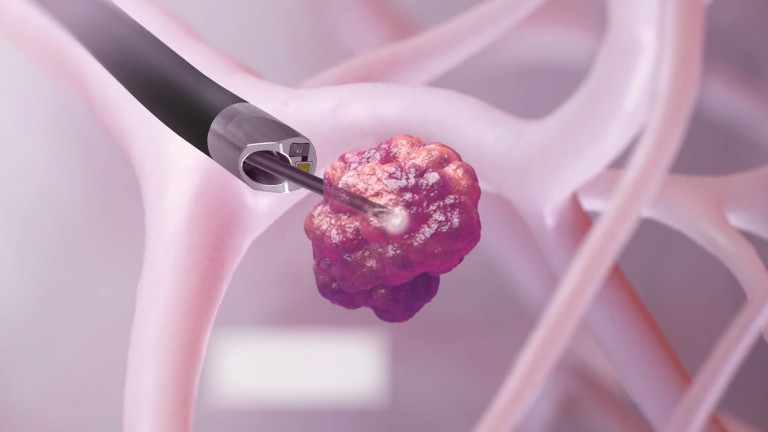
Bronchoscopy is a technique used to look at your airways with a small camera on the end of a flexible tube. When this technique is robotic-assisted, physicians are able to move the tube with better precision and access parts of the lungs that may have been challenging with traditional bronchoscopy.

Typically, a bronchoscopy is an outpatient procedure, meaning you don’t have to stay overnight in a hospital. Even better, it usually takes less than an hour and you will be asleep through the whole thing. Bronchoscopy is usually a safe procedure but there is a risk of bleeding, infection, or lung collapse.

Using robotic-assisted bronchoscopy, the physician can examine the lungs, reach targets set through a CT scan and precisely collect tissue that may be lung cancer. Modern tools such as robotic-assisted bronchoscopy are able to guide physicians in all areas of the lung, enabling more accurate biopsies, diagnosis and treatment.
The Procedure

Once you are asleep, the physician will examine your lungs to collect tissue samples from the areas of concern using the Galaxy System™ which is designed to deliver the most accurate lung cancer diagnosis and minimize complications.* After the tissue is collected, a diagnosis can be made by a pathologist and your care team will let you know the results and if treatment is required.

After the procedure, your healthcare team will monitor you to ensure you are breathing and swallowing properly. You will likely experience numbness in your mouth and throat that will dissipate within a few hours. You may also have a sore throat, cough, or hoarseness after the procedure for the next 24 hours1.
Galaxy reaching a lung nodule to be removed

Our Interventional Pulmonologists

Dr. Andra Fee and Dr. Tejpreet Lamba

Dr. Fee and Dr. Lamba with the Galaxy Robotic System

Patients can receive a consultation with Dr. Andra Fee, DO or Dr. Tejpreet “TJ” Singh Lamba, MBBS, MD at Pulmonary Associates of Meadville, located in Meadville Medical Center’s Liberty Street Medical Arts Building.
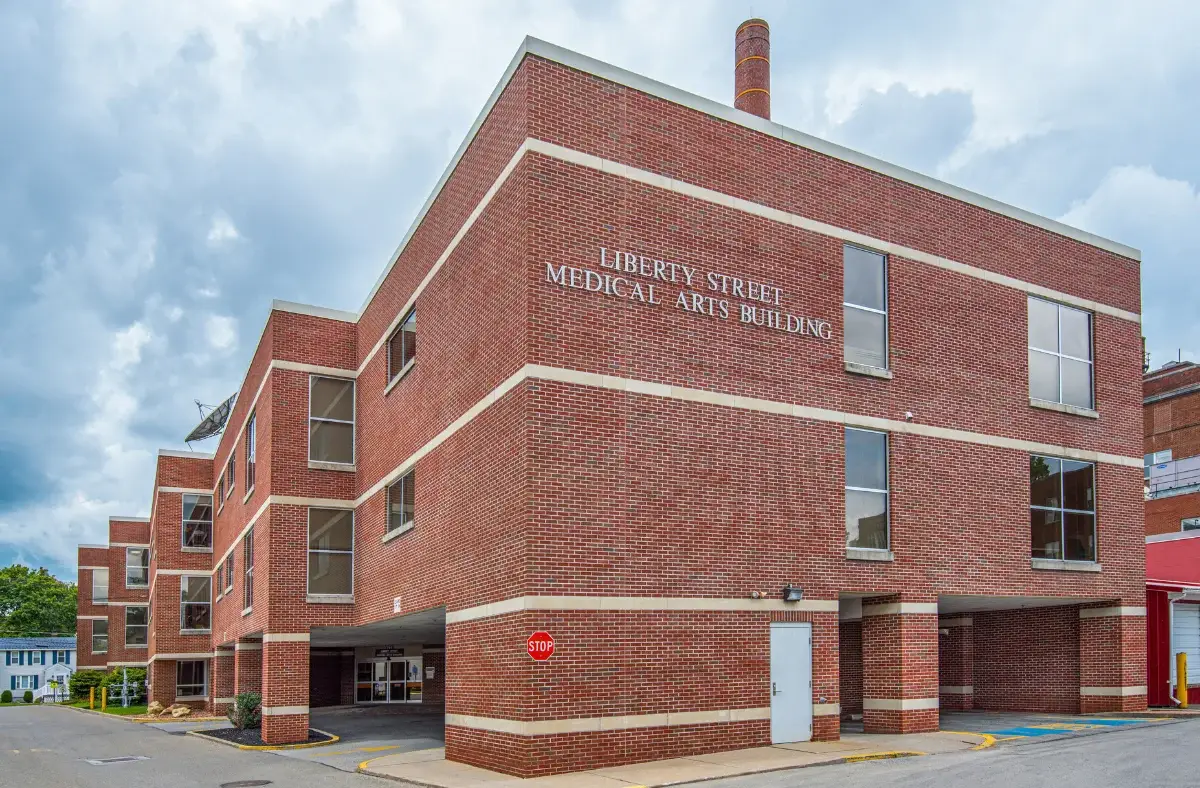
Meadville Medical Center Liberty Street Medical Arts Building
Liberty Street Medical Arts Building
765 Liberty Street, Meadville, PA, 16335
View Location Details
1. American Cancer Society – https://www.cancer.org/cancer/types/lung-cancer/detection-diagnosis-staging/signs-symptoms.html

2. National Cancer Institute, Lung Cancer Report 2022 – https://seer.cancer.gov/statfacts/html/lungb.html

3. Kalinke L, Thakrar R, Janes SM. The promises and challenges of early non-small cell lung cancer detection: patient perceptions, low-dose CT screening, bronchoscopy and biomarkers. Mol Oncol. 2021 Oct;15(10):2544-2564. doi: 10.1002/1878-0261.12864. Epub 2020 Dec 14. PMID: 33252175; PMCID: PMC8486568.

4. American Lung Association – https://www.lung.org/getmedia/381ca407-a4e9-4069-b24b-195811f29a00/SOLC-2020-Report-Final

* https://doi.org/10.1016/j.pccm.2023.01.001
Click to access the login or register cheese